
AC vs DC Forklifts: Why AC Motor Technology Is Superior for Business
If you’re still evaluating DC motor electric forklifts in 2026, there’s a real chance you’re being offered older inventory or an outdated design. Here’s the technical breakdown on why the industry moved to AC—and why it matters for your operation.
DC motors have brushes. Carbon brushes contact the commutator ring to transfer current. They wear down. Industry average is replacement every 500–1,000 operating hours—roughly every 6–12 months in a busy single-shift operation. That’s a scheduled maintenance item with associated cost and downtime. AC brushless motors have no contact wear components in the drive system. The maintenance interval basically disappears.
AC motors regenerate braking energy. When you release the throttle or hit the brake, an AC motor controller captures the kinetic energy and feeds it back into the battery. On a standard warehouse cycle—lots of short runs, stops, and direction changes—regenerative braking can recover 10–20% of energy that would otherwise become heat. That extends your shift runtime without changing the battery size.
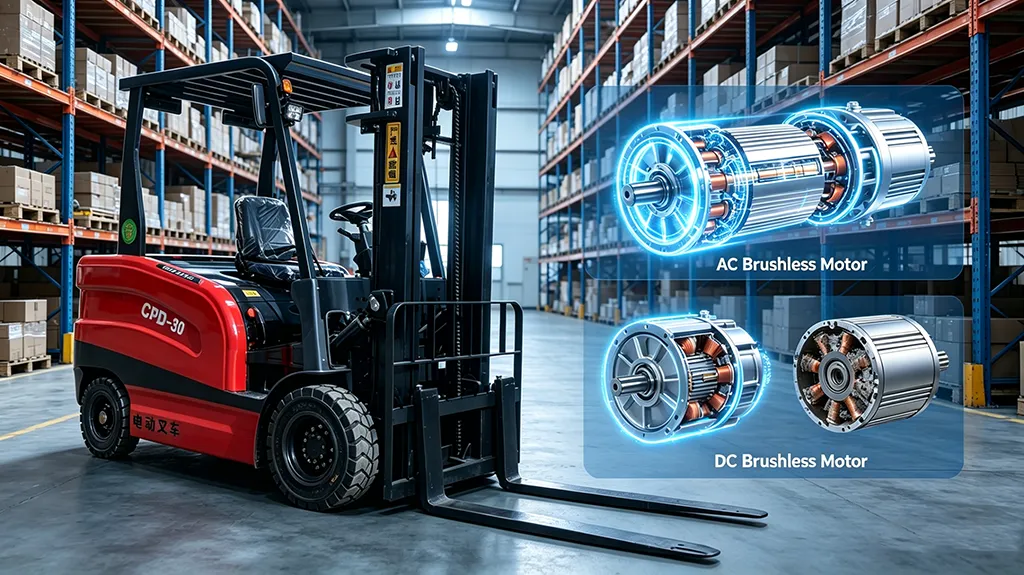
Thermal management is better in AC. DC motors run hotter under load, which reduces efficiency and accelerates brush wear. AC motors maintain efficiency across a wider operating temperature range, which matters in summer conditions or high-cycle operations.
Response and control feel different. AC motors deliver torque more linearly across the RPM range. Operators describe the feel as smoother and more predictable—important in tight maneuvering situations. DC motors can feel jerky at low speed, which matters when you’re inching into a racking slot.
All models in our CPD series—from the CPD-15 to the CPD-35—run 4000W AC brushless motors for both travel and hydraulics. That’s not a marketing spec; it’s the baseline requirement for any competitive machine in 2026.
If a supplier is quoting DC motors at a lower price, factor in the brush replacement cost before deciding it’s a bargain.