
Remote Mower Maintenance: Essential Checks to Prevent Breakdowns
Remote control mowers are mechanically simpler than the equipment they replace—no operator cab, no seat, no steering wheel column assembly. But “simpler” isn’t the same as “maintenance-free.” Field experience from customers across 80+ countries has given us a clear picture of where breakdowns actually originate.
Blade condition is everything. A dull or damaged blade creates vibration that propagates through the deck into the drive system and frame. On brush-clearing operations, blade edge wear happens faster than operators expect. Check blade sharpness every 8–12 hours of operating time in tough vegetation. On maintained turf, every 20–25 hours is reasonable.
The SN-1100D and SN-1000B use bolt-on blade systems that allow replacement without special tools. Keep a spare set on the truck.
Track tension and condition (tracked models). Under-tensioned tracks skip and slip. Over-tensioned tracks accelerate bearing wear. Check tension every 20 hours by measuring sag at the midpoint—manufacturer spec is in the manual, typically 10–15mm deflection. Check the track surface for cuts, splits, or chunking after every job on abrasive terrain (gravel, rocky hillsides).
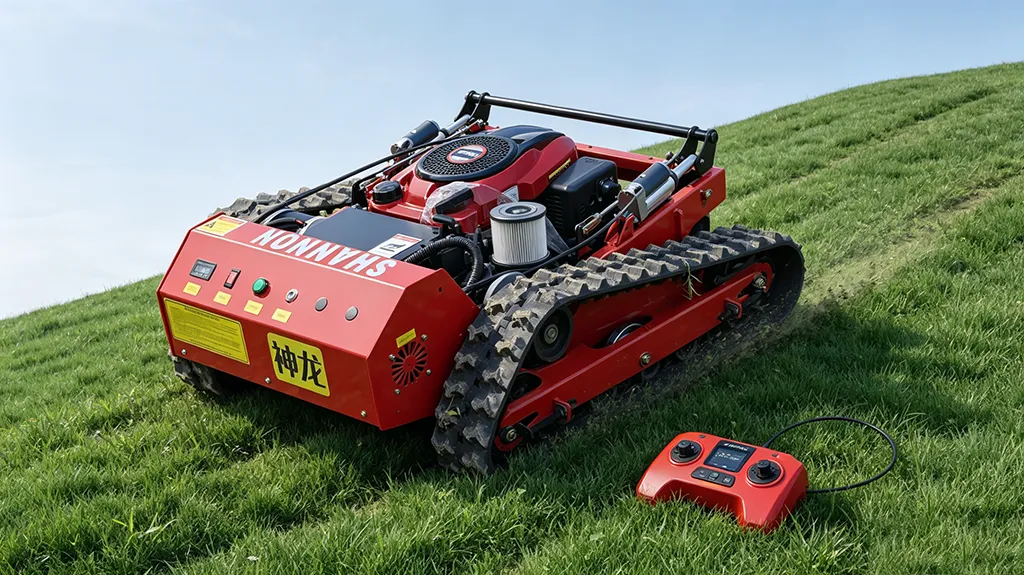
Air filter attention on gas engines. Mowing generates significant airborne chaff, grass particles, and dust. The engine air filter in brush mowing applications needs inspection every 10–15 hours. A clogged filter chokes the engine, reduces power, and causes the machine to bog in heavy vegetation. This is one of the most common causes of “power loss” complaints we see—and one of the cheapest fixes.
Remote system care: The 2.4G transmitter is an outdoor tool. Protect it from water ingress during cleaning (don’t pressure-wash it) and from drops. Check antenna condition periodically. A bent or damaged antenna reduces range before you notice it.
The SN-300T electric tracked utility vehicle has different maintenance requirements being battery-driven—battery connection checks, motor controller ventilation clearance, and waterproofing integrity after operations in wet grass.
Write down your hours. The difference between a mower that runs for 5 years and one that becomes a parts machine in year 2 is usually documentation discipline, not machine quality.