
Remote Control Mowers: Why Contractors Are Retiring Their Ride-On Mowers
Nobody gets excited about changing the way they mow. It’s not the kind of decision that happens at a trade show over coffee. It usually happens after someone gets hurt on a slope, or a liability claim lands on the desk, or a client site turns out to have a 40-degree embankment that no operator should be riding on.
That’s usually when the conversation about remote control mowers gets serious.
The slope problem is real. Most ride-on mowers are rated to about 15–20 degrees. Some push to 25. Anything steeper and you’re operating outside the machine’s stability envelope—technically against manufacturer specs, often against insurance policy terms, and definitely against common sense. Remote control tracked mowers change that ceiling dramatically.
The SN-1000B heavy duty brush mower is rated to 55 degrees. That’s not 55 from vertical—that’s 55 from horizontal. For reference, a 45-degree slope is what most people would call “very steep.” This machine works comfortably at angles that would tip a ride-on and seriously injure a push-mower operator.
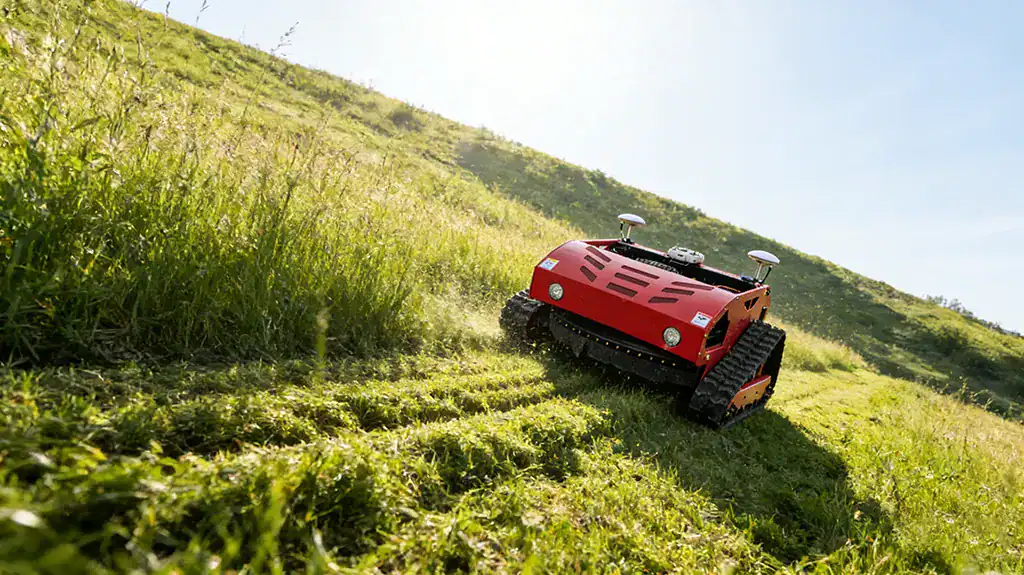
Operator fatigue is the hidden cost. A human pushing or riding for 6–8 hours on rough terrain makes more errors in hours 5–8 than hours 1–4. Remote control operation eliminates physical fatigue from the equation entirely. The operator stands at a safe distance, uses the 2.4G controller, and finishes the day without back pain.
Job scope expands. Contractors running remote control mowers can take on contracts they’d previously declined—steep roadside embankments, solar farm vegetation management, reservoir banks. That’s direct revenue expansion, not just efficiency improvement.
The shift is happening. The question is timing.
Explore our full mower lineup → | WhatsApp: +86 138 0537 3583 | [email protected]