
Tracked vs Wheeled Mowers: Choosing the Right Remote Control Machine
You’ll see both configurations in our lineup, and the choice matters more than most buyers realize before they’re standing on a job site wondering why their machine won’t grip.
Tracked mowers: designed for the difficult stuff. Rubber tracks distribute the machine’s weight across a longer contact patch. On soft ground, wet slopes, or uneven terrain, that weight distribution prevents the sinking and slipping that wheels struggle with. The SN-550D tracked slope mower and the SN-1000DL are the go-to configurations for embankment work, reservoir edges, and anything with soft ground beneath the grass.
Tracked machines also hold lines on slopes better. Wheels tend to slip sideways on gradients; tracks grip and hold position. If your primary application is hillside mowing—road banks, solar farms, commercial orchard rows on sloped terrain—tracked is the right answer.
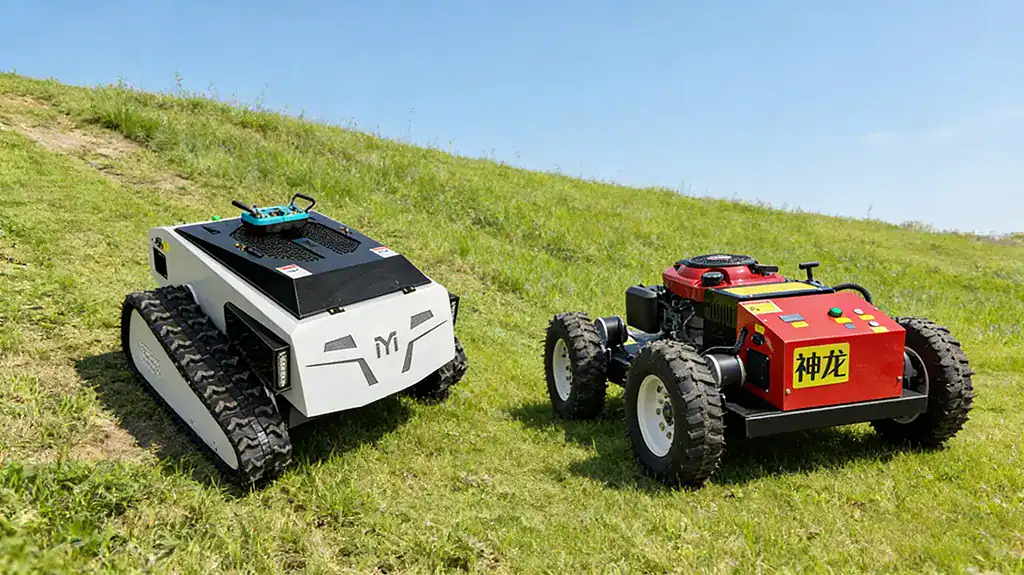
The trade-off: Tracks wear. On abrasive surfaces (gravel roads, concrete edges, rocky terrain), track life shortens and replacement cost adds up. On smooth, flat applications, tracks are also slower and less maneuverable than wheels.
Wheeled mowers: efficiency on flat and moderate slopes. The SN-550S and SN-550W cover golf courses, large lawn estates, sports fields, and commercial parks where the terrain is relatively even and high mowing speed matters. Better turning radius than tracked, lower ground pressure on healthy turf, and typically lower unit cost.
The honest answer on which to buy: tell us your primary application. Slopes above 20–25 degrees consistently? Tracked. Flat to moderate terrain with occasional gentle slopes? Wheeled is more efficient and costs less to run.
A site that mixes both types of terrain is a candidate for two machines, or for the heavier tracked models that can handle both. The SN-1000B is an example of a machine that goes anywhere—at the cost of being heavier and more powerful than you need for flat manicured lawn.